PMS Performance
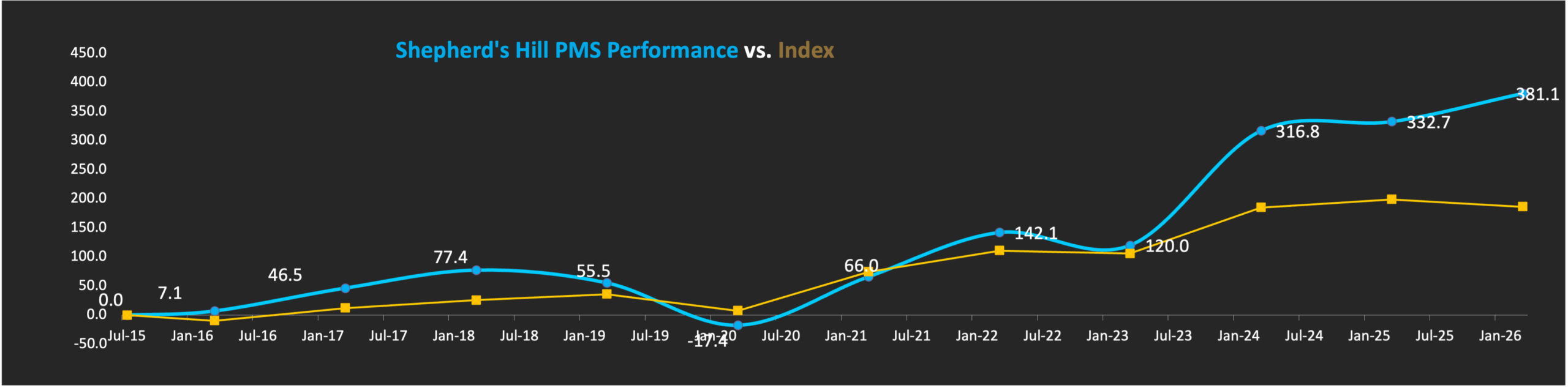
| Annualised Returns – TWRR | ||||||
| Particular | 1 month | 1 year | 3 year | 5 year | 10 year | Since Inception (Aug 2015) |
| Shepherd’s Hill PMS | -7.03% | 11.18% | 29.80% | 23.72% | 16.21% | 15.87% |
| Benchmark – Index | -11.40% | -4.16% | 11.59% | 10.42% | 12.19% | 10.37% |
*Updated March 31, 2026
What Shepherd’s Hill PMS Does
Shepherd’s Hill is an investment manager based in India, licensed by SEBI (India’s investment regulator) since 2015. It runs a single investment approach called ‘Value Magno’ — a strategy that looks for well-run Indian companies whose shares are available at prices below what those businesses are actually worth. The manager holds these shares over the long term, waiting for the market to recognise their true value.
The portfolio typically holds 15 to 20 companies at any one time — spread broadly across company sizes, from large household names to smaller, less well-known businesses. Dividends received are reinvested rather than paid out, compounding growth over time.
The firm does not charge a fixed annual management fee. Instead, it earns 22% of any profits earned above a 6% annual return. If returns fall below 6% in any year, that shortfall carries forward and must be recovered before any fees are charged. This structure means the manager only benefits meaningfully when clients do well.
Long-Term Performance Record
The above table shows how the PMS has performed over meaningful holding periods — the kind of timeframes that matter for a long-term investor. These are annualised figures, meaning the average return earned per year over each period, net of all fees and charges.
What These Numbers Mean for a Careful, Long-Term Investor
Over the ten years to March 2026, an investor in Shepherd’s Hill PMS earned approximately 16.21% per year on their money. The broad Indian stock market index returned about 12.19% per year over the same period. The difference — roughly 4 percentage points per year — may appear small, but compounded over a decade it translates into meaningfully more wealth.
Since the PMS began operating in August 2015 — a period spanning more than ten years and including sharp market downturns such as the COVID-19 crash — the fund has returned 15.87% per year against the index’s 10.37% per year. An investor who stayed through the full period would have accumulated significantly more than someone who simply tracked the market.
The five-year figure of 23.72% per year and the three-year figure of 29.80% per year reflect a period of strong underlying business performance across the portfolio. These figures are encouraging but should be viewed as part of the longer record, not in isolation.
Independent data sources have ranked this fund as the No. 1 PMS in India over a five-year period (as of March 2026), and in the top 10 PMS funds over three-year, five-year, and ten-year periods. These rankings are based on performance among all registered PMS funds in India.
How Capital Is Protected
Shepherd’s Hill states that protecting the investor’s money is its primary goal, with growing it being the secondary objective. This ordering reflects a conservative disposition. The fund does not use borrowed money (leverage), does not trade in futures or options, and does not engage in short-term buying and selling.
When the fund manager cannot find companies available at prices that represent good value, a portion of the portfolio may be held in cash or safe, income-earning instruments rather than being forced into overpriced investments. This willingness to sit on the sidelines is an important safeguard in expensive markets.
The portfolio is kept deliberately concentrated at 15 to 20 companies. This is fewer than most mutual funds (which may hold 50 to 100 stocks), allowing the manager to focus deeply on each holding while still spreading risk meaningfully.
The Investment Approach in Plain Terms
The fund looks for Indian companies that are worth more than their current share price implies. This gap between price and underlying value can arise for many reasons — temporary business difficulties, a poorly-understood business, or simply a period of general pessimism in financial markets. The fund buys during these windows of underpricing and holds until the gap closes.
Before buying any company, the manager reviews multiple years of financial statements, checks for red flags such as excessive debt or questionable management behaviour, assesses the quality of the business itself (its competitive position, its customer relationships, the calibre of its leadership), and compares it against other opportunities available at the same time.
The manager, Rishi Gupta, has over 20 years of experience investing in Indian capital markets, holds a degree from Stanford University, and has worked in private equity. He is personally involved in every investment decision.
Who Can Invest and What Is Required
This PMS is open to Indian residents and Non-Resident Indians (NRIs). The minimum investment amount is Rs. 50 lakh (approximately Rs. 5 million). Investors are asked to commit to a minimum holding period of five years. Early withdrawal is possible but carries a declining fee: 3% in the first year, 2% in the second, 1% in the third, and nothing from year four onward.
Investor accounts (both bank and share-holding) are held in the investor’s own name, not pooled with others. The custodian — the independent institution that holds and safeguards the assets — is Kotak Mahindra Bank, one of India’s large private banks. Annual accounts are audited by Deloitte Haskins & Sells LLP.
Investors receive a quarterly report, a personalised login to check their account daily, and direct access to the management team. The firm works directly with clients and does not operate through commission-paying agents or distributors.
Key Facts at a Glance
- SEBI-registered PMS since July 2015.
- Single investment strategy: value-focused, market cap agnostic, India equities only
- 10-year annualised return: 16.21% per year vs 12.19% for the index (as of March 31, 2026)
- Since inception (Aug 2015) annualised return: 15.87% per year vs 10.37% for the index
- Ranked No. 1 PMS in India over 5 years; top 10 over 3, 5 and 10 years
- No fixed management fee; performance fee of 22% on profits above a 6% annual hurdle
- Portfolio of 15 to 20 companies; no leverage, no derivatives, no short-term trading
- Minimum investment Rs. 50 lakh; 5-year commitment required
- Custodian: Kotak Mahindra Bank; annual auditor: Deloitte Haskins & Sells LLP
- Open to Indian residents and NRIs; accounts held in investor’s own name
Disclaimer
This document is for informational purposes only. It is not an offer or solicitation to invest. Returns are past figures and are not a guarantee of future performance. PMS returns shown are net of fees, transaction taxes, and third-party charges. Returns for periods greater than one year are annualised. Performance data has not been verified by SEBI. Prospective investors should read the full disclosure document and consult a qualified financial advisor before making any investment decision.