Ranked by  in
in
with a five year track record
having a flexi-cap equity fund strategy.
* data as of 31/03/2026.
Ranked by in
Over a 3 year period AND
Over a 5 year period AND
Over a 10 year period
* data as of 31/03/2026.
Shepherd's Hill PMS - Performance Data
Shepherd’s Hill Portfolio Management Service, or PMS, received its license to operate from SEBI in July 2015. Shepherd’s Hill has been operating only one approach – the value-focused market-cap agnostic approach called ‘Value Magno’. The basic objective for the PMS is to provide savers a way to invest in the Indian equity market and achieve capital protection and superior long-term returns.
The following is a 8 year track record of the PMS. As required by SEBI, it is a notionally pooled Time-Weighted Net Rate of Return for all transactions that we have managed within the PMS approach.
This data is being provided for informational purposes only. Past performance may not be an indicator of future returns. PMS returns are net of fees, transaction taxes and third party charges. Returns for periods greater than one year are annualised and not required to be reported to SEBI. Performance related information provided herein is not verified by SEBI.
SHEPHERD'S HILL
PMS Performance
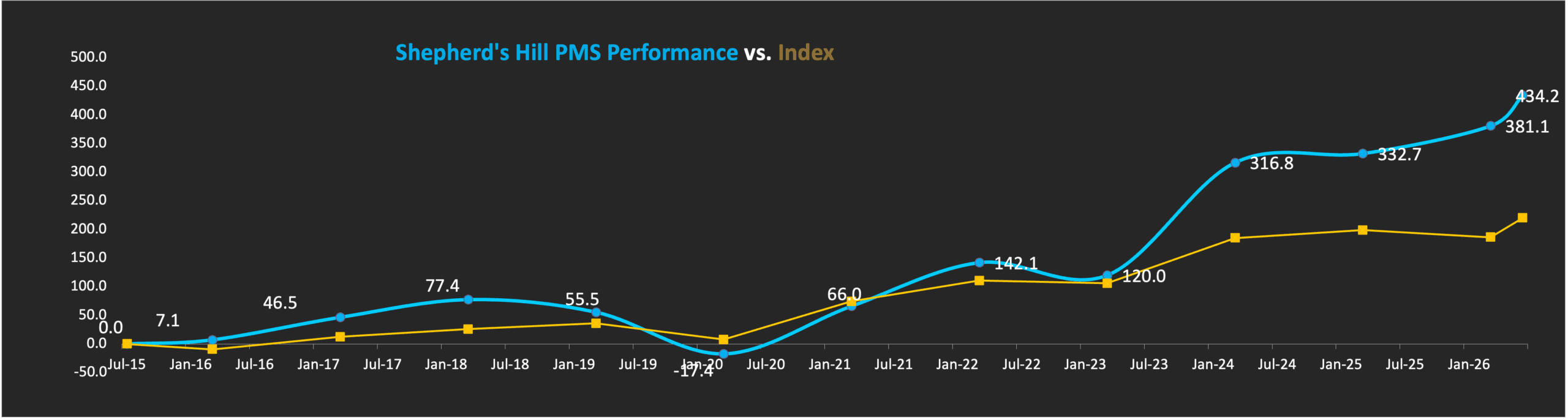
| Annualised Returns – TWRR | ||||||
| Particular | 1 month | 1 year | 3 year | 5 year | 10 year | Since Inception (Aug 2015) |
| Shepherd’s Hill PMS | 0.67% | 3.80% | 22.60% | 18.91% | 15.49% | 16.59% |
| Benchmark – Index | 1.53% | -2.93% | 11.30% | 10.87% | 12.54% | 11.25% |
*Updated June 30, 2026

Portfolio Management Services (PMS)
Shepherd’s Hill offers discretionary portfolio management services (PMS India). This means you let us manage your money, similar to a mutual fund. However, PMS managers have advantages over mutual funds, being a smaller size and able to provide personalised service.
Shepherd’s Hill PMS is one of the only PMS providers in India that does not charge any client a fixed management fee. Fees paid by PMS clients are purely based on performance.
INVESTMENT PHILOSOPHY
We are long-term, equity-focused value investors. We look for companies that have intrinsic or inherent value that are not priced correctly by the market for some short-term or irrational reasons. While this is not easy, because the market is very efficient in its assessments, it is not impossible.
MARKET-CAP AGNOSTIC (MAGNO)
Shepherd’s Hill PMS India, because of its relatively smaller size, is able to take positions in small and medium-capitalisation companies in addition to large, bluechip companies in India. The size advantage allows the PMS to find mis-priced “hidden gems” and large, well-known companies.
STRONG INTEREST ALIGNMENT
The PMS charges only a performance fee of 22% of profits over a hurdle rate of 6% per annum. If the return in any year is less than 6%, then the shortfall is added to the subsequent year’s hurdle. This fee structure creates a high degree of alignment of interests between client and Fund Manager.
BALANCED PORTFOLIO
The PMS will maintain a balance between diversification and focus by holding roughly 15-20 positions in the portfolio. This framework seeks to avoid the risk of concentration while seeking to outperform the India index (NIFTY) or the average India mutual fund that has 50 or 100 stocks in it.
FOCUS ON INDIAN SECURITIES
We have a 5+ years track record and expertise in India’s capital markets as a PMS India service provider. We received SEBI’s PMS India license in 2015. Our focus is on securities of companies that are listed on India’s stock exchanges. We can accept India residents and Non-Resident Indians (NRI) as PMS investors.
SECTOR-AGNOSTIC
The PMS uses a bottom-up approach to investment management. This means the focus is on company-level operations and environments. Investment decisions are made purely on the merits of the security under consideration. We do not perform macro or sector analyses as a starting point for our research.
PROTECTION OF CAPITAL
The primary objective of the PMS is protection of capital over the long term. Our clients are saving money for important purposes such as retirement or children’s education. The secondary objective is earning superior returns. We do not do short-term trading or leverage through derivatives, futures and options, etc.
LONG-TERM TIME HORIZON
Our PMS requires all new investors to commit to an investment time period of 5 years. This long-term perspective allows the PMS to take advantage of “time-arbitrage” opportunities. That is, the PMS buys good, well-run companies in India at prices that are overly discounted due to short-term considerations.
Who can invest
Who Can Invest in Shepherd's Hill PMS India?

Minimum investible capital of ₹50 lakhs

5-year commitment

Must be a resident or non-resident Indian
Frequently Asked Questions for PMS
Find clear and concise answers to common questions about asset management, helping you make informed decisions with confidence.
What Is a PMS?
A PMS, or Portfolio Management Service, colloquially sometimes also called Portfolio Management Scheme, is a service which you can use to save and invest money. PMS services / Portfolio Management Schemes / Portfolio Management Services can be of many types and have many strategies. Typically, a PMS manager will manage a bank and demat account for you (in your name) through which you will be able to invest funds. PMS services are regulated in India and a PMS Funds in India must have a license from the Securities and Exchange Board of India (SEBI), India’s security regulator.
What is a discretionary PMS?
A discretionary PMS investment / Portfolio Management Scheme / Portfolio Management Services gives full discretion to the PMS fund manager to deploy your funds in India in the manner it sees fit. Once the PMS India agreement is signed, the PMS India fund manager will have the final call on the PMS / Portfolio Management Scheme / Portfolio Management Services investments and the client may have limited to no influence on Portfolio Management Scheme or Portfolio Management Services.
Who is the Fund Manager of Shepherd's Hill PMS?
Mr. Rishi Gupta is the fund manager. He has more than 20 years of experience in the capital markets. He is a graduate of Stanford University and was a private equity professional. He has been professionally investing in India since 2008. He has experience interacting and working with top management at the CXO and board of director levels and is a proven judge of managerial character and competence. He has international experience and can assess global market factors affecting a company’s business. He is personally involved in the detailed quantitative and qualitative research that goes into an investment decision of the PMS services / Portfolio Management Services / Portfolio Management Scheme. He personally reviews the PMS investment portfolio to make sure it is correctly positioned and balanced.
Can you share some stock names in the portfolio?
While we are happy to walk you through our process and hypothetical examples of the types of companies our PMS India invests in, we cannot share proprietary information about PMS investments i.e. portfolio holdings of the PMS / Portfolio Management Scheme / Portfolio Management Services.
Can I get a better / different fee structure?
The fee structure in the PMS India is carefully designed to be fair to clients. The reason the hurdle rate is 6% is because the management fee is 0%. If the management fee was 1 or 2% we could have kept the hurdle rate higher, but we believe the 0% management fee structure produces the best alignment of interests between our clients and us – like a true partnership. (PMS India – applicable for the Portfolio Management Services / Portfolio Management Scheme)
Is there an early withdrawal fee in the PMS?
Yes, the early withdrawal fee for the PMS services is 3% in the first year, 2% in the second year, 1% in the third year and there is no withdrawal fee from the PMS accounts after three years.
Do all PMS clients have the same "model" portfolio?
No. We do not follow a single model portfolio in the PMS India. PMS investment clients have portfolios based on their time of entry. A portfolio management scheme suitable in 2017 would not be suitable in 2020, even though multiple core holdings might remain the same. We follow the buy/hold/sell-range system. That is, each idea or holding of the PMS funds has a price range within which we would buy, hold or sell it at any given point in time.
What is the percentage break-up by sector and market capitalisation in the PMS portfolio?
There is no hard and fast rule since the PMS schemes fund manager has flexibility based on available ideas. This break-up in the PMS services portfolio would be different at different points in time based on market conditions in India at that point of time.
What is the PMS account opening process?
PMS – For India residents:
When you are ready to start, please send us required details and scans of your PAN card and address proof. Within 24 hours, we will dispatch a document package to you for your signatures. On return of the completed document set, and following an in-person verification (IPV) by the bank, the bank and demat accounts will be opened (this takes about 4-5 working days). After this, investments can begin.
For NRIs coming into the PMS India the paperwork is more cumbersome and, depending on whether a PMS NRE or NRO account is being opened, the time-frame can also be longer as there might be approvals required from the Reserve Bank of India (RBI).
AIF – When you are ready to start, please send us required details and scans of your PAN card, Address proof, your demat client master list, and a cancelled cheque. Within 24 hours, we will dispatch a document package to you for your signatures. On return of the completed document set, accounts will be opened (this takes about 4-5 working days). After this, investments can begin.
Can you manage my existing accounts as part of the PMS?
No. We will be opening new specific portfolio management services bank and demat accounts for you in the Shepherd’s Hill Portfolio Management Services India, as these PMS investment accounts will be linked to each other and maintaining, operating and book-keeping for the exclusive PMS investment accounts is much more operationally efficient.
Can I transfer shares to the PMS account?
No, you cannot transfer securities directly into the Portfolio Management Services in India accounts. You must transfer funds to the PMS services bank account (a self-transfer, since this account will be in your name) through checks or through online banking to begin the PMS invest programme.
Can I directly access my PMS bank and demat accounts?
No, since the PMS India / PMS schemes accounts are custodian accounts, you will not have direct access to the bank and demat accounts. However, all PMS funds account holders will be given Shepherd’s Hill login facilities so that all India resident and NRI investors can check PMS account details at their convenience.
Who is the Portfolio Management Services ( PMS ) custodian?
Kotak Mahindra Bank Ltd., one of India’s largest private banks, is the SEBI-registered custodian appointed for Shepherd’s Hill Portfolio Management Services in India (PMS India) clients.
Will I get regular income / dividends from the PMS?
No, all dividends/income that is received in your Portfolio Management Scheme accounts will be reinvested. Dividend income received on your Portfolio Management Scheme portfolio is usually 1-2% per year on average. You are free to proactively withdraw any amount from the Portfolio Management Scheme at any time, subject to applicable early withdrawal fees, as long as the PMS schemes account balance does not go below Rs. 50 lakhs.
Can I do a systematic investment plan (SIP) or add more funds to my PMS bank account?
Yes, the PMS fund offers this option. Once the initial amount of minimum Rs. 50 lakhs is funded in your PMS funds account, you can add funds to the PMS funds bank account at any time, in lump sum or in tranches. This will be duly invested by the PMS funds manager.
How will you protect me when there is a market crash?
- There is no way to completely insulate yourself from a market downturn in the short-term with PMS investment. However, if you stick with the PMS investment over the long term, our portfolio creation and stock selection aims to ensure that your PMS investment will recover and even exceed the previous market highs over time.
- If we feel that market prices are exceedingly high and no attractive ideas are available, we may keep a material part of the PMS funds in cash, liquid fixed income instruments or gold ETFs. This may provide some protection on the down side in the PMS invest.
How are you better than a mutual fund?
- Our portfolio management services (PMS funds total assets) are small so we have more flexibility and opportunities to invest in good smaller companies.
- Our portfolio management services (PMS services) have a more focused portfolio so we can outperform the index by a bigger margin if our decisions are good.
- Our Portfolio Management Scheme (PMS schemes) have a highly aligned fee structure. No management fees.
- In our PMS investment, we work directly with our clients. We do not work through agents or distributors who earn commissions.
- Mutual funds generally have higher portfolio churns. Our PMS investment portfolio churn is very low.
What are the reports I will receive as a PMS client?
A quarterly report will be provided when you invest in PMS, which will include:
- Macroeconomic commentary by the Fund Manager
- Return statistics of the PMS funds portfolio
- PMS investment account holdings and transactions statements
- Dividends and income information
- Any other pertinent information regarding the PMS services
Deloitte Haskins & Sells LLP has been appointed to audit all clients’ accounts of the Portfolio Management Services in India and produce a certified set of statements including balance sheet and P&L for the PMS investment account after the end of each fiscal year. This will include tax information and capital gains statements to help file your tax returns.
Once you invest in PMS, you will get login credentials to our website shepherdshill.in where you will be able to see high level PMS NAV and return data on a daily basis, in addition to sector-wise portfolio composition.
For any queries, clarifications, or details you can easily access our relationship managers and management team, as we are a small firm.
What are the tax implications of investing in a PMS?
Taxes in your PMS India / PMS schemes accounts are the same as if you were investing directly through your personal account. The main income in your PMS India accounts will be capital gains and dividends. Tax rates on these incomes are subject to change from time to time and will depend on your individual circumstances when you invest in PMS. Please consult a certified chartered accountant for tax advice regarding your PMS investment.
What is the investment process and how do you select companies in the PMS?
The following are the steps in our PMS investment process:
Screening and Short-listing. We use proprietary screening tools and software to focus on only those companies in India that we believe merit further research and analysis. With approximately 5,000 listed companies on the India exchanges, the PMS focuses research on a high-quality subset with the goal of achieving operational efficiencies.
Checklist Verification. The Portfolio Management Services team will employ a proprietary checklist to identify any red flags that appear with respect to a potential investment. Issues for scrutiny include related party transactions, joint ventures, equity or debt investments in other companies, loans and advances that have been written off, exorbitant salaries to managers, and preferential allotments.
Financial Analysis. The Portfolio Management Services team will perform an extensive quantitative analysis with respect to potential investments in India. We will analyse multiple years of publicly available data to create a financial picture covering many facets of operations, including profit margins, return on assets, debt levels, operating leverage, and dividend yields.
Qualitative Research. The Portfolio Management Scheme will research and judge the qualitative aspects of each potential investment. Topics relevant to this part of the process include management quality, minority shareholder communication (including quarterly investor calls), business moats, and relationships with suppliers and customers.
Comparative Analysis. When the number of available investment opportunities for the Portfolio Management Scheme exceeds the number of investments that the portfolio can contain, the PMS funds manager will compare ideas to each other in order to assess the relative attractiveness of each. Considerations relevant to this analysis include over- or under-exposure in an industry sector and perceived correlations between assets.
Decision Point. A deliberate decision is taken on the choice of portfolio company considering all factors, with price of entry being a key consideration.
Continuous Portfolio Monitoring. Once an investment decision has been made for Portfolio Management Scheme, we will monitor each position continuously. Along with each investment decision, we will monitor the entire PMS funds portfolio in an effort to ensure that any portfolio-level risks are considered and mitigated to the extent possible.
What is the difference between Portfolio Management Scheme and Portfolio Management Services?
As an investor, it’s useful to know that Portfolio Management Services is the official SEBI term, and that what many people casually call a Portfolio Management Scheme is the very same thing in practice. When you open an account, you engage a registered Portfolio Manager to deliver Portfolio Management Services—discretionary or non-discretionary management of your securities under a written agreement—even if a brochure or friend describes that engagement as a Portfolio Management Scheme. Your onboarding, KYC, custody, brokerage execution, reporting, and audits are identical whether a factsheet headlines Portfolio Management Services or a distributor says Portfolio Management Scheme. For due diligence, compare mandate design, risk controls, fees, benchmark, and drawdown history; do not infer any product difference from the phrase Portfolio Management Scheme versus Portfolio Management Services. In formal documents, SEBI requires providers to be registered for Portfolio Management Services, and your rights, disclosures, and protections are anchored to that label; the phrase Portfolio Management Scheme persists only as market shorthand. Day to day, your experience—asset allocation, security selection, rebalancing, and periodic reviews—remains the same whether a pitch deck repeats Portfolio Management Services or an advisor’s email repeats Portfolio Management Scheme. If you see both terms side by side, read them as interchangeable: you are evaluating one engagement model. In short, treat Portfolio Management Services as the definitive regulatory name, and treat Portfolio Management Scheme as an alternate phrasing for the same investor-facing service—choose a manager for process and fit, not for whether they say Portfolio Management Services or Portfolio Management Scheme.
Investment Process
Step-by-Step Flow of Our Investment Process
Screening & Shortlisting
The Fund Manager (FM) will use proprietary screening tools and software to focus on only those companies that it believes merit further research and analysis. With approximately 5,000 listed companies on the Indian exchanges, the FM plans to focus research on a high-quality subset with the goal of achieving operational efficiencies.
Checklist Verification
The FM will employ a proprietary checklist it has developed to identify any red flags that appear with respect to a potential investment. Issues for scrutiny include related party transactions, joint ventures, equity or debt investments in other companies, loans and advances that have been written off, exorbitant salaries to managers, and preferential allotments.
Financial analysis
The FM will perform an extensive quantitative analysis with respect to potential investments. The FM will analyse multiple years of publicly available data to create a financial picture covering many facets of operations, including profit margins, return on assets, debt levels, operating leverage, and dividend yields.
Qualitative research
The FM will research and judge the qualitative aspects of each potential investment. Topics relevant to this part of the process include management quality, minority shareholder communication (including quarterly investor calls), business moats, and relationships with suppliers and customers.
Comparitive Analysis
When the number of available investment opportunities exceeds the number of investments that the portfolio can contain, the Investment Manager will compare ideas to each other in order to assess the relative attractiveness of each. Considerations relevant to this analysis include over- or under-exposure in an industry sector and perceived correlations between assets.
Decision Point
A deliberate decision is taken on choice of portfolio company considering all factors, with price of entry being key.
Continuous Portfolio Management
Once an investment decision has been made, the FM will monitor its position continuously. Along with each investment decision, the FM will monitor the entire portfolio in an effort to ensure that any portfolio-level risks are considered and mitigated to the extent possible.
Schedule a call to discuss your financial goals
Our asset management services are designed to optimize your investments and grow your wealth. We focus on the equity asset class to enable your long term objectives.
Schedule a call with our teamContact us
Get in Touch to Discuss Your Investment Requirements
Mumbai Address:B5, STC Society, NS Phadke Marg, Andheri (E), Mumbai 400069.
Phone:+91 20 7127 9247
Insights for Informed Investments
Explore insights, trends, and strategies in asset management. Stay informed with expert analysis and updates to help you make smarter investment decisions.